
A Military PPM Rate Calculator is designed to provide an estimate based on the information you enter, such as your household goods (HHG) weight, travel distance, move type, and estimated moving expenses. While the calculator cannot replace your official reimbursement determination, it gives you a practical starting point for planning your move and understanding how different factors may affect your estimated payment. Many service members assume there is a fixed payment per pound or a simple reimbursement formula. In reality, several factors work together when estimating a Personally Procured Move, including the Government Constructed Cost (GCC), your authorized shipment weight, travel details, and current military relocation guidance.
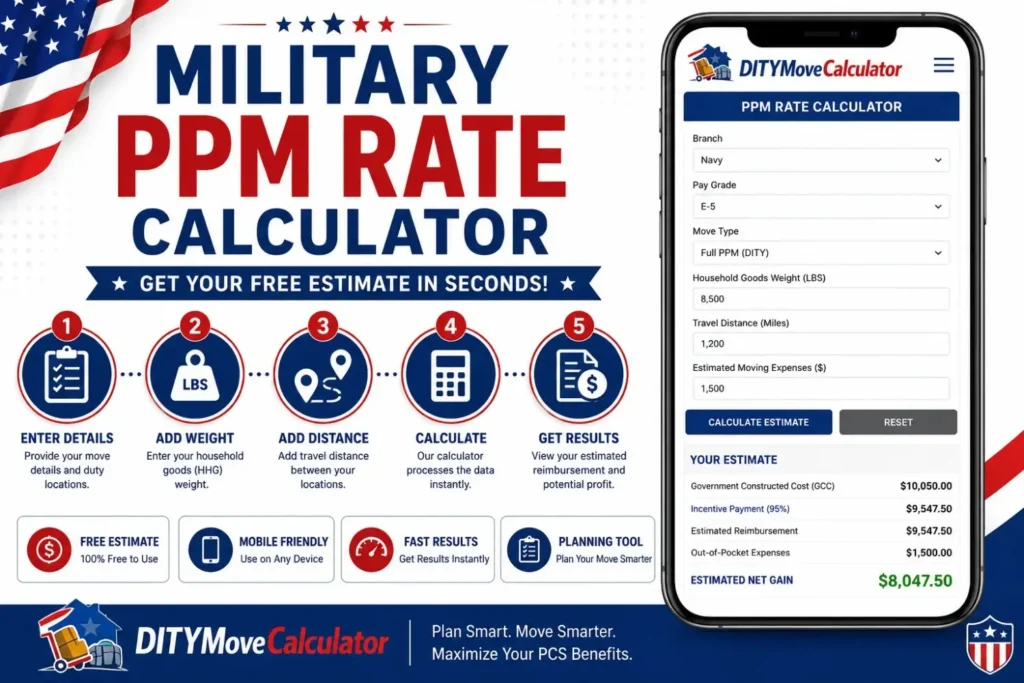
Knowing how these factors fit together can help you make better decisions before moving day. Whether you’re serving in the Army, Navy, Air Force, Marine Corps, Coast Guard, or Space Force, estimating your reimbursement early gives you more confidence when planning your PCS. It also makes it easier to compare your expected moving costs with your estimated reimbursement, helping you decide whether a Full or Partial PPM is the right choice for your situation. Use our Military PPM Rate Calculator to explore different moving scenarios, estimate your potential reimbursement, and prepare for your next PCS with greater confidence. A few minutes of planning today can help you make smarter financial decisions throughout your move.
Looking for a complete reimbursement estimate? Try our DITY Move Calculator to compare your moving expenses, estimated incentive payment, and Government Constructed Cost.
What Is a Military PPM Rate?
A Military PPM rate is an estimated value used to help calculate how much reimbursement you may receive when you complete a Personally Procured Move (PPM) during a Permanent Change of Station (PCS). Instead of hiring the government to move your household goods, you arrange all or part of the move yourself. If your move qualifies, you may receive reimbursement based on current military relocation rules. Many service members think there is a fixed PPM rate per pound, but that’s not how the process works. There isn’t one flat payment that applies to every move. Your estimated reimbursement depends on several factors, including your household goods (HHG) weight, travel distance, move type, and the Government Constructed Cost (GCC). Because every PCS is different, reimbursement amounts can vary from one move to another.
A Military PPM Rate Calculator brings these details together to provide a planning estimate before your move begins. By entering your estimated shipment weight, travel information, and moving expenses, you can see how different choices may affect your expected reimbursement. This makes it easier to compare moving options and build a realistic PCS budget. For example, moving a small apartment a few hundred miles is very different from relocating a large family home across the country. The estimated reimbursement for these two moves is unlikely to be the same because the shipment weight, transportation costs, and travel requirements are different.It’s also important to understand that the calculator provides an estimate, not an official payment amount.
Your final reimbursement is determined after your move is complete and your documents—such as certified weight tickets, PCS orders, receipts, and other required paperwork—have been reviewed by your military transportation office. Whether you serve in the Army, Navy, Air Force, Marine Corps, Coast Guard, or Space Force, understanding how Military PPM rates work can help you make smarter decisions before moving day. A few minutes spent estimating your reimbursement today can help you avoid unexpected costs and plan your PCS with greater confidence.
How Does a Military PPM Rate Calculator Work?
A Military PPM Rate Calculator helps you estimate the financial side of your Personally Procured Move before your PCS begins. By entering a few planning details, you can quickly see an estimated reimbursement, compare expected moving costs, and prepare a more realistic relocation budget.
Enter Your PCS Move Details
Start by selecting your move type, such as a Full or Partial PPM, and enter your current and new duty stations. These details provide the foundation for your estimated reimbursement and help determine the overall scope of your move.
Add Your Household Goods Weight
Enter the estimated weight of the household goods you plan to transport. If you have not received certified weight tickets yet, a reasonable estimate can still help you understand how your shipment size may affect your planning.
Include Travel Distance & Moving Costs
Add your estimated travel distance along with expected expenses such as truck rental, fuel, packing materials, storage, or hired moving assistance. These costs help you compare your estimated payment with your expected budget.
Generate Your Estimate
Once your information is entered, the calculator processes everything instantly and creates an estimated reimbursement based on the values you provided. This gives you a quick financial overview before your move begins.
Review Your Estimated Results
The calculator displays estimated reimbursement details so you can compare your expected payment with your planned expenses. This makes it easier to adjust your moving strategy before your PCS orders are completed.
Your Estimated Results May Include
| No. | Military Pay Grade | Category |
|---|---|---|
| 1 | E-1 | Enlisted |
| 2 | E-2 | Enlisted |
| 3 | E-3 | Enlisted |
| 4 | E-4 | Enlisted |
| 5 | E-5 | Enlisted |
| 6 | E-6 | Enlisted |
| 7 | E-7 | Enlisted |
| 8 | E-8 | Enlisted |
| 9 | E-9 | Enlisted |
| 10 | W-1 | Warrant Officer |
| 11 | W-2 | Warrant Officer |
| 12 | W-3 | Warrant Officer |
| 13 | W-4 | Warrant Officer |
| 14 | W-5 | Warrant Officer |
| 15 | O-1 | Commissioned Officer |
| 16 | O-2 | Commissioned Officer |
| 17 | O-3 | Commissioned Officer |
| 18 | O-4 | Commissioned Officer |
| 19 | O-5 | Commissioned Officer |
| 20 | O-6 | Commissioned Officer |
| 21 | O-7 | General/Flag Officer |
| 22 | O-8 | General/Flag Officer |
| 23 | O-9 | General/Flag Officer |
| 24 | O-10 | General/Flag Officer |
What Information Affects Your PPM Rate?
There is no single rate that applies to every Personally Procured Move (PPM). Each military move is different, so your estimated reimbursement depends on the details of your relocation. Entering accurate information into the calculator gives you a more reliable estimate and helps you plan your Permanent Change of Station (PCS) with greater confidence.
Household Goods Weight
Your estimated Household Goods (HHG) weight is one of the biggest factors in your reimbursement estimate. Furniture, clothing, kitchen items, electronics, and other personal belongings all contribute to the total shipment weight.
A weight estimate that is close to your actual shipment gives you a better idea of what your move may look like financially. If you are unsure, using a household goods weight estimator is often better than making a rough guess.
PCS Distance
The distance between your current duty station and your new assignment affects the overall cost of moving your household goods. In general, longer moves involve higher transportation costs than shorter relocations.
Entering the correct starting point and destination helps the calculator produce a more realistic estimate for your move.
Government Constructed Cost (GCC)
The Government Constructed Cost (GCC) is an estimate of what it would cost the government to move your household goods through an approved transportation provider.
This value is an important part of the reimbursement process. Although it is not paid directly to you, it helps determine your estimated incentive payment during a Personally Procured Move.
Moving Expenses
Most military moves include expenses such as truck rental, fuel, packing supplies, storage, tolls, or hired moving help. Tracking these costs gives you a better understanding of your total moving budget.
Comparing your expected expenses with your estimated reimbursement helps you see whether you may finish your move under or over budget.
Travel Allowances
Depending on your PCS orders, you may receive reimbursement for certain travel-related expenses. Mileage, lodging, and other authorized travel costs can affect your overall relocation budget.
Including your travel information helps create a more complete estimate and gives you a clearer picture of your total moving costs.
Move Type
Whether you choose a Full PPM or a Partial PPM can influence your reimbursement estimate. A Full PPM means you manage the entire move yourself, while a Partial PPM allows you to move only part of your household goods and let the government handle the rest.
Selecting the correct move type ensures the calculator reflects your planned relocation as accurately as possible.
Planning Tip
One lesson many experienced military families learn is that small details can make a big difference. Before using the calculator, take a few extra minutes to estimate your household goods weight, check your travel distance, and list your expected moving expenses. The more accurate your information is, the more useful your reimbursement estimate will be when planning your PCS budget.
Frequently Asked Questions
Below are answers to common questions about military PPM rates, reimbursement estimates, and PCS planning. These explanations are intended to help you understand how the process works before you begin your move.
A military PPM rate is part of the process used to estimate reimbursement for a Personally Procured Move (PPM). It is not a fixed payment or a single amount that applies to every move. Your estimate depends on details such as your household goods weight, travel distance, move type, and current relocation guidance.
No. Reimbursement estimates can change over time because transportation costs and military relocation guidance are updated periodically. If you’re planning a PCS, it’s a good idea to use current information instead of relying on estimates from previous years.
Yes. The estimated weight of your household goods is one of the most important parts of a reimbursement estimate. A larger shipment usually costs more to transport than a smaller one, which is why entering a realistic weight helps produce a more useful estimate.
Travel distance is an important part of planning a PCS. Depending on your authorized travel and relocation details, mileage and other travel-related allowances may be considered when estimating your overall moving budget. Your official reimbursement is based on your approved travel and supporting documents.
Government Constructed Cost, often called GCC, is an estimate of what it would cost the government to move your household goods using an approved transportation provider. It is an important part of the reimbursement process, but it is not the amount paid directly to you.
Yes. A Military PPM Rate Calculator can help you estimate your potential reimbursement before your move begins. While the result is only an estimate, it gives you a better understanding of your expected moving costs and helps you plan your PCS budget with greater confidence.
Yes. The calculator can be used by Army personnel planning an authorized Personally Procured Move. It provides an estimate based on the information you enter, while your final reimbursement is determined through the official review process.
Yes. Air Force members can use the calculator to estimate moving costs and potential reimbursement before relocating. It is designed as a planning tool and should not replace the official guidance provided by your transportation office.
Yes. Navy personnel can use the calculator to compare moving scenarios and estimate reimbursement during PCS planning. Keeping accurate information, such as household goods weight and expected expenses, will produce a more reliable estimate.